
Geoengineering cometh
My latest piece in The Atlantic.



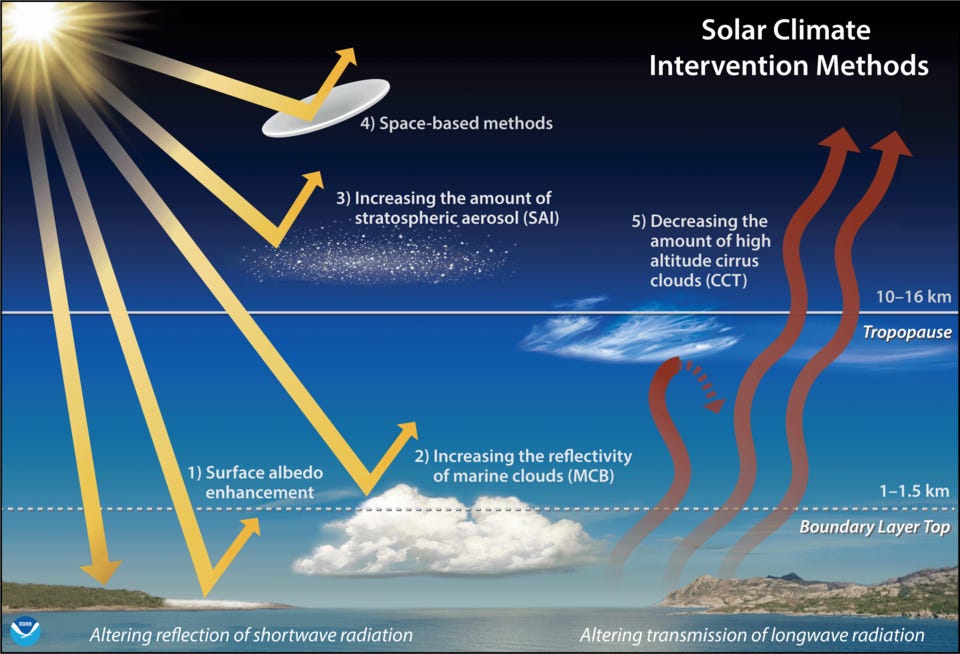
When I first started writing about climate change, geoengineering was the scary third-rail of policy discourse. At the time, it included many things. Geoengineering most commonly referred to proposals to spray aerosols into the atmosphere to reflect the sun’s energy back into the space and artificially cool the planet. The term also often referred to carbon removal technology, such as direct air capture. Either way, they were verboten “false solutions,” and even entertaining them invited accusations of climate denialism. If we could manipulate how badly global warming felt, or if we could vacuum up the carbon dioxide emissions later, we would have no more will to mitigate those greenhouse gases now. At least, that’s what the dominant strain of activist thought preached.
In 2018, a book opened my mind and gave me the courage to think critically about these issues. After Geoengineering by the University at Buffalo academic Holly Jean Buck laid out different kinds of potential technologies that might give humanity the power to deliberately alter the climate, and illustrated their effects with snappy short stories. This was the stuff of science fiction, so some actual science fiction was warranted.
Since then, the world has kept getting hotter, decarbonization has grown more complex, and while the global clean-energy boom has bent the curve on global warming, we’re still on track to blow past the Paris Agreement’s target of capping warming at 2 degree Celsius above pre-industrial averages.
For these reasons, the scientific consensus on the question of whether to research geoengineering — just in case it’s needed — has shifted in recent years largely toward answering yes.
In The Atlantic this morning, I have a new piece that discusses the debate and the shifting politics of opposition to opening this proverbial Pandora’s box:
After years of being treated as fringe notions, all of these ideas are gaining traction. The billionaire Peter Thiel has backed geoengineering work. Elon Musk has expressed his support for start-ups pursuing the technology. One Silicon Valley-backed company, Make Sunsets, went as far as carrying out a rogue experiment in Baja California in 2022. Left-wing environmental circles have long criticized even researching these technologies; now some activists (who see climate change as its own form of unintentional geoengineering) argue that geoengineering technologies are a way of reversing capitalism’s climate sins. U.S.-government labs have been actively investigating what it would mean to pour sulfur dioxide into the Arctic atmosphere. Stardust Solutions, an Israeli-U.S. start-up that wants to commercialize reflective-aerosol technology, recently raised $60 million; the company’s aim, CEO Yanai Yedvab told me, is to give governments the information they need to weigh whether to deploy this technology. Bill Gates has publicly been arguing that the climate movement should worry less about emissions goals and more about improving life in a hotter future; at a private lunch I attended last month, he said that dramatic tools such as geoengineering technologies would be good to have “in the arsenal” of climate adaptations.
Like most geoengineering supporters, Gates meant only that we should understand these tools better. More research, after all, would not guarantee deployment. Virtually no advocates are publicly arguing for deploying geoengineering at present; they are arguing only for publicly funded (and therefore publicly accountable) programs.
But at the same moment that scientific and business leaders are softening to the idea of geoengineering, the political opposition in the U.S. is growing. “The politics are wildly bipolar,” Craig Segall, a senior adviser to the Federation of American Scientists and a former top lawyer at the California Air Resources Board, told me. In recent years, he himself has embraced the need to research geoengineering, but he has also watched opponents on both ends of the political spectrum dig in. On the left, the most extreme thinkers argue that the world should be talking only about mitigating emissions—that the solution to climate change is dramatically scaling back energy production. On the right, a contingent of MAGA leaders have become vocal adversaries to geoengineering research and are using it to feed conspiracy theories about government manipulation of the atmosphere.
You can read the full story here.
Want to receive more original reporting via this newsletter? Help me prioritize this platform by making it a bigger share of my income. Subscribe today for a year-long package and save nearly 20%:
PROGRAMMING NOTES: Over the past few months, my habit has been to only publish original stories and the weekly Sunday Revue in this newsletter, and round up my recent stories elsewhere in this section. But I realized the effect of this strategy has been to stymie the growth of this audience because I’m waiting on something original to publish here, when I write constantly for many other publications. Going forward, I’m going to start sending out new stories regularly here as standalone newsletters. They will, of course, remain free for all subscribers; I would never charge anyone for a link to something I wrote elsehwere. I’ll try to keep them brief and have some value add, like my ode to Holly Jean Buck above.
If you find this publishing cadence annoying, or if you have suggestions on how to better feature my other work on this newsletter, I’m open as always to your thoughts. Just reply to this email.
Got a tip? Reply to this email or text me on Signal:

Signing off from sunny Bay Ridge, Brooklyn, where I’m trying out a new organic yerba mate today.