
This map should alarm you
A quick look at North America's growing risk of blackouts.

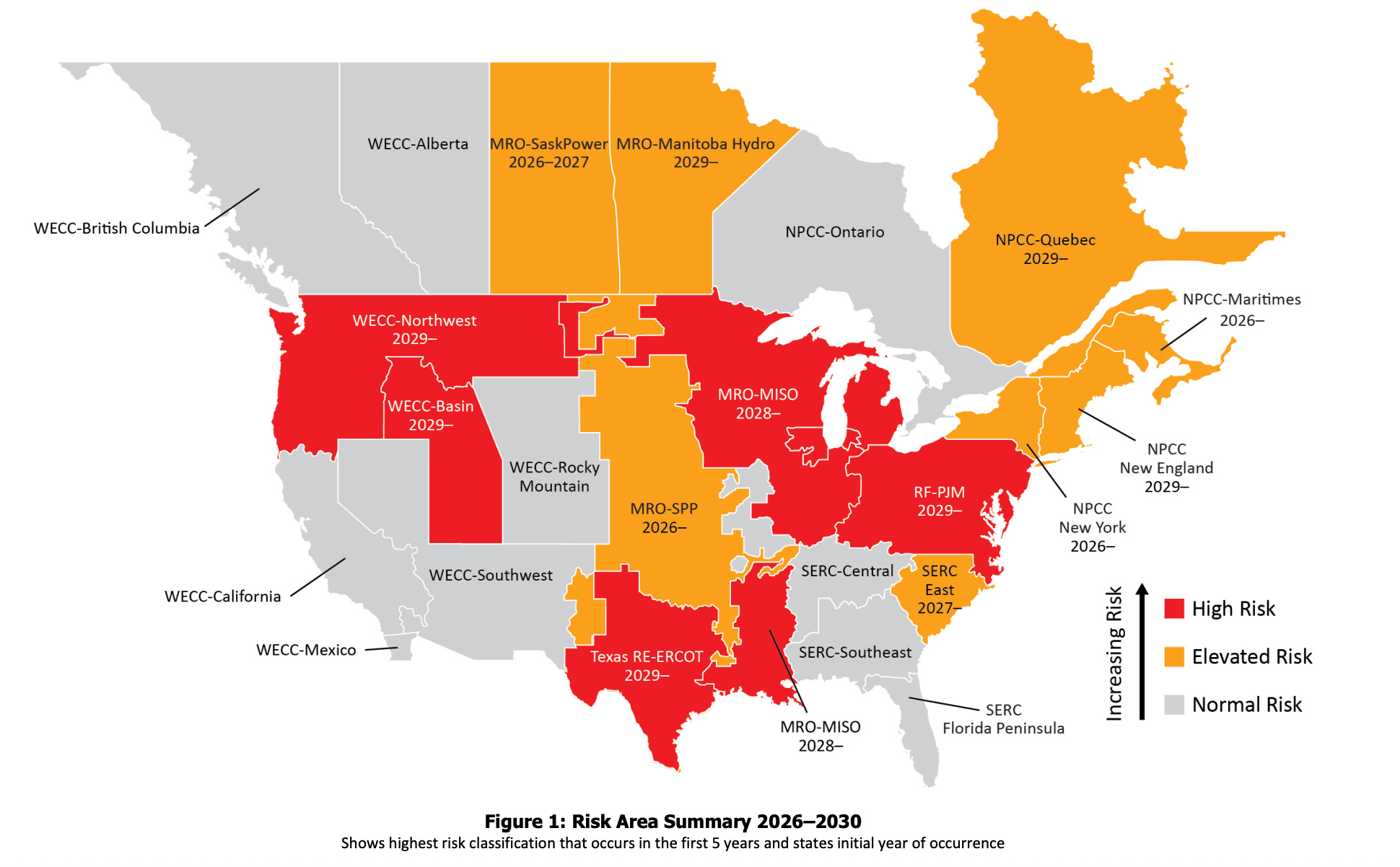
Every year, the North American Electric Reliability Corporation — a quasi-governmental watchdog group that monitors the health of the power grids in the United States and Canada — publishes its analysis of where things are headed for the Anglo-French portion of the continent.
The 2025 report just came out, and America is bathed in a sea of red.
That’s the color code for grid systems that face a high risk blackouts from between now and 2030.
The Midcontinent Independent System Operator, the 15-state grid that covers much of the American Midwest, faces particularly dire conditions, slipping into code-yellow “elevated risk” next year and code-red “high risk” in 2028. The reason? “Projected resource additions do not keep pace with escalating demand forecasts and announced generator retirements.”
PJM Interconnection, the largest grid system in the U.S. covering much of the Mid-Atlantic, is already at “elevated risk.” By 2029, that’s set to become “high risk.” As in the Midwest, new power plants can’t open fast enough to meet surging demand from data centers. “Current projections for resource additions do not keep pace with escalating demand forecasts and expected generator retirement.”
Texas’ ERCOT grid is on the track as PJM, going from today’s code-yellow to code-red in 2029 as “continued rapid load growth outpaces projected resource additions in later years.”
Risk levels in the grid that covers the Rockies and the Great Basin are escalating at the same pace as in Texas. Once again, it’s a familiar reasoning: Demand is surging faster than power plants can come online, and older stations are retiring, widening the gap. But NERC added that most of the new power resources coming online are solar panels, which the watchdog warned lead “to a more variable resource mix.”
The grid in the Pacific Northwest is fine until 2029, when it abruptly plunges into high risk red. Surging demand is a big driver, but NERC also warned that the system is becoming increasingly reliant on “solar PV, battery, and wind, leading to a more variable resource mix.”
The picture is similarly concerning in regions that, despite not going code-red, remain at elevated risk.
Take New York, for instance, which is set to remain in yellow status from now through the end of the decade. The problem is particularly acute in New York City, where the planned retirement of oil- and gas-burning “peaker” plants that come online only when the demand is particularly high is adding stress to a system still reeling from losing the Indian Point nuclear station.
Despite its high costs, New England’s grid is OK until 2028 when “strong demand growth and persistent winter natural gas infrastructure limitations pose risks of energy shortfalls in extreme winter conditions.”
Now here’s another issue. Both New York and New England are looking to stabilize their grids by linking up with the cheap, dependable, and carbon-free hydroelectric system in neighboring Québec. But during last weekend’s Winter Storm Fern, electricity stopped flowing from Canada to New England on the new power line that just came online as the state-owned utility Hydro-Quebec halted exports to deal with surging demand at home. Québec started shipping power again on Monday. But it could be a sign of things to come. NERC gave Québec’s grid a pass until 2028, when “demand growth projections” are set to outpace new power generation, “leading to projected resource shortfalls in the winter season.” The emphasis there is mine.
So, what’s the takeaway here? We need to start building more power plants and transmission lines, and we probably should embrace tools such as a demand response (if you don’t know what that is, read this previous newsletter).
If you thought high prices were the biggest problem facing American ratepayers, ask a Puerto Rican what it’s like to lose access to a reliable grid.
I try my best to make this Substack worth your time with balanced, original analysis and reporting. If you like it, please consider making the process of writing it more worth my time by chipping in $5 a month for a premium subscription.
Signing off from Arctic Bay Ridge, Brooklyn, where the sidewalks are still fringed by small glaciers.
Strategic power reserves for hungry strategic AI are posed to compete with people for power and water and everything else. And no one can afford to deprioritize them