
Poland's hot rocks
An update on a story I wrote last year.

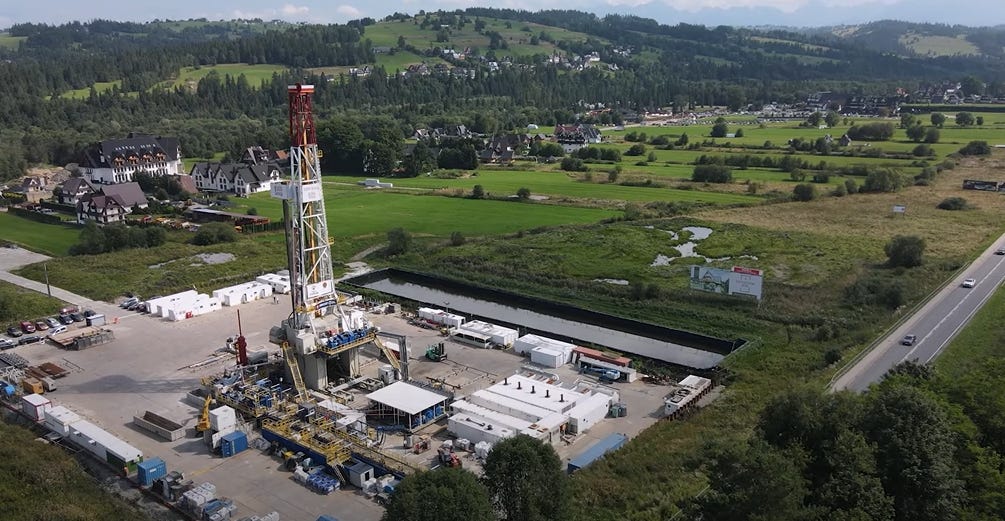
Back in September, while I was attending the Polish Economic Forum in the mountain town of Karpacz, I met Rafal Szkaradzinski, the rakish and affable mayor of the tiny village of Szaflary. The village near the Slovak border matters because it’s the site of a unique experiment: energy-hungry Poland’s leading effort to tap into geothermal heat. But the project was facing problems, namely that the new center-left government in Warsaw didn’t care as much about geothermal as nuclear or other renewables such as wind and solar.
From the story I ended up writing a month later for Latitude Media:
As coal-addicted Poland scrambles to supply its surging demand for electricity with cleaner sources, this effort represents one of the fast-growing economy’s most significant experiments in geothermal energy. Once complete, the project, known as Banska PGP-4, would be the world’s deepest geothermal well.
For a country scrambling to lock down more reliable, clean, and domestic resources of energy, geothermal could supply nearly one-third of the nation’s demand for heat. It could potentially come online years before the various nuclear reactors under development go critical, helping to stave off blackouts as aging coal plants start shutting down. And for the United States — where there is rare bipartisan bullishness on the future of new geothermal plants and selling energy technology overseas — Poland could serve as a key export market in Europe.
However, according to Szaflary’s mayor, Poland’s development of geothermal power is stalling due to partisan divides over energy.
“Right now, the government just doesn’t want to make more projects in geothermal,” Rafal Szkaradzinski told Latitude Media in an interview on the sidelines of last month’s Economic Forum conference in Karpacz. “They are finishing old projects, but we don’t have any new money for building what comes next.”
That’s potentially bad news for the U.S. geothermal industry as well. As Poland has grown economically in the last three decades, its demand for energy has grown in parallel, particularly for American exports; imports of U.S. liquefied natural gas jumped nearly 250% between 2019 and 2024. In 2022, Poland selected the U.S. nuclear giant Westinghouse to build its first atomic energy station, choosing the higher-end AP1000 technology partly out of a desire to cement its diplomatic relationship with Washington.
The project was only meant to provide district heating in Poland, today a major source of energy demand that’s met by burning coal. So when I was perusing the trade publication Think GeoEnergy this past weekend, you can you imagine that a story about the potential for the site to produce electricity.
From the story:
With well testing now completed, the initial temperature and flowrate parameters measured from the 6000-meter well in Szaflary, Poland have exceeded expectations. As Mayor Rafal Szkaradzinski explains, the well’s parameters support the possibility of electricity production, which could be a pioneering project for Poland.
The geothermal well to be drilled in Szaflary had set an ambitious target depth of 7000 meters, as first announced back in 2023. Drilling of the Banska PGP-4 well officially started in April 2023 and was completed in April 2025. The operations ran into several technical problems, including very slow rate of penetration through hard rock formation and equipment failure. The decision was then made to terminate the well at 6103.2 meters, substantially short of the target.
Despite not reaching the target depth, the Mayor states that both the temperature and flowrate were higher than anticipated. The waters had temperatures of around 120 °C, flowrates of up to 400 cubic meters per hour, and low mineralization. The well also intersected a newly discovered aquifer at about 5000 meters depth, which the municipality plans to exploit for production. Thus, electricity generation is now being considered from the well, which will be a first in Poland.
“Generating electricity from geothermal sources is a pioneering project on a national scale; no other well in Poland has similar parameters. The area in which we are located offers unique opportunities,” said Szkaradzinski.
As Poland races to find alternatives to coal, this is a project worth keeping an eye on.
Want to support independent, nonpartisan energy journalism? Consider upgrading to a paid subscription for just $5 a month. It’s like buying me a beer, or a coffee, except cheaper than the type of place I’d probably recommend we go.
Signing off from frigid Bay Ridge, Brooklyn, where the neighborhood is mourning the loss of The Leif, an Irish pub so old its name harkens to the early 20th century Norwegian diaspora that once made up the bulk of the population here.